A Technical Analysis of the Solo Mini Localizer Dome vs. the Single Localizer Sound Dome
Engineering Hemispheric Audio Isolation
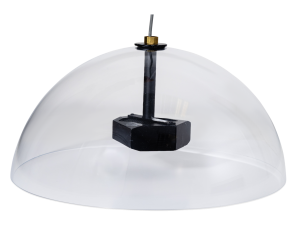 When an installation requires high-fidelity, full-range audio containment without any bleed into adjacent spaces, overhead acoustic domes are the definitive engineering choice. Unlike parametric ultrasound speakers that rely on air demodulation, sound domes use physical geometric containment.
By placing high-precision transducers at the focal point of a rigid hemispheric shell, these systems bounce and consolidate audio waves downward. This creates a strictly defined “shroud” of sound that replicates a headphone experience without the hardware contact.
Today, we compare two premier structural solutions from Brown Innovations: the compact Solo Mini Localizer Sound Dome and the flagship Single Localizer Sound Dome. Please note that the Solo Dome is only available for hire, whilst the Single is for hire and sale.
The Contenders at a Glance
While both systems leverage patented hemispheric dome geometry—which prevents the un-focused audio “spray” typical of standard parabolic designs—they are scaled for vastly different spatial limitations and listener counts.
| Technical Parameter | Solo Mini Localizer Sound Dome | Single Localizer Sound Dome |
| Acoustic Geometry | Compact Hemispheric Dome | Flagship Hemispheric Dome |
| Dome Diameter | 20.0″ (50.8 cm) | 32.0″ (81.3 cm) |
| Dome Height | 10.0″ (25.4 cm) | 16.0″ (40.6 cm) |
| System Weight | 3.60 kg | 7.71 kg |
| Isolation Rating | Up to 14 dB | Up to 20+ dB |
| Stereo Separation | 10 dB | 10 dB |
| Frequency Response | 150 Hz – 20 kHz | 150 Hz – 20 kHz |
| Amplifier Drive | Myriad II (Outboard Required) | Myriad II (Outboard Required) |
1. Physical Footprint and Structural Load
In architectural integration, overhead space and ceiling structural capacity dictate hardware limits. Domes require careful planning due to their physical volume.
Solo Mini Localizer Dome: Minimalist Integration
The Solo Mini features a tight 20-inch (50.8 cm) diameter and a low-profile 10-inch height. Weighing in at a nimble 3.60 kg, it drastically reduces structural calculation issues.
- The Architecture: It is built specifically for tight retail environments, low ceilings, or instances where multiple domes must be hung close together on a single lighting truss or lightweight drop-ceiling grid without overloading the hardware support systems.
Single Localizer Dome: The Architectural Flagship
The Single Localizer is a commanding structural element, featuring a 32-inch (81.3 cm) diameter and a 16-inch depth. Weighing 7.71 kg, it requires dedicated suspension hardware, such as steel wire and Gripple kits anchored directly to structural decks.
- The Architecture: The larger physical footprint is a necessary acoustic byproduct. A larger dome volume captures and redirects lower frequency waves far more effectively than a compact shell, optimizing the acoustic barrier.
Both domes can be hung either by steel wire, or floor mounts or wall mounts – both of which are available for hire or sale.
2. Beam Directionality and the Audio Footprint
The primary distinction between these two systems lies in the scale of their listening envelopes and the maximum acoustic isolation achievable at the floor line.
Solo Mini Localizer Dome: Ultra-Confined Targeting
Because of its smaller 20-inch aperture, the Solo Mini projects a razor-thin acoustic envelope.
- The Footprint: It creates a highly restricted listening region measuring roughly 12 inches wide by 12 inches deep directly beneath the center axis of the dome.
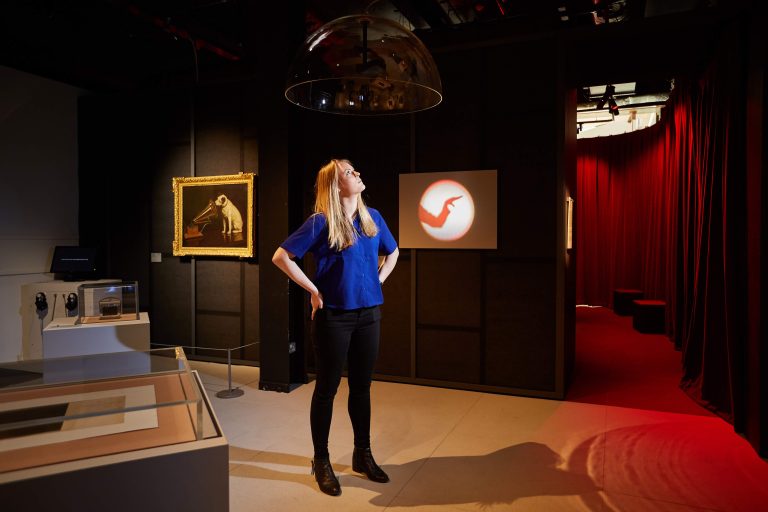
- The Isolation Profile: It provides a solid 14dB of isolation from the surrounding room. This means the audio drop-off is sudden and aggressive. It is designed for a single, stationary listener—such as an individual standing in front of an ATM, a terminal, or a narrow museum display.
Single Localizer Dome: The Gold Standard Corridor
The flagship 32-inch Single Localizer delivers the apex of audio isolation technology. Interestingly, the optimal listening area is engineered to sit slightly offset—roughly 10 inches toward the front edge of the dome rather than dead center.
- The Footprint: It provides a significantly larger, more comfortable listening envelope of roughly 24 inches wide by 24 inches deep (61 cm x 61cm). This comfortably accommodates one tall adult or two people standing side-by-side.
- The Isolation Profile: The large hemispheric lip yields an exceptional 20dB isolation rating. This allows you to raise the playback volume to compete with heavy ambient noise floors while maintaining a complete drop-off outside the footprint. Step two paces away, and the audio effectively vanishes into the room’s background noise.
Summary: Strategic Deployment
Choosing between these hemispheric arrays depends on the available spatial layout and the flexibility required for the listener:
- Select the Solo Mini Localizer Dome when ceiling real estate is limited, structural weight thresholds are low, and you need to target a single, precisely positioned user without any visual or physical clutter.
- Select the Single Localizer Sound Dome when you have ample overhead clearance and your priority is maximum acoustic isolation alongside a wider, more natural listening envelope that can easily support a couple or small family group.
Discover which directional speaker matches your requirements
Answer a few questions to learn what’s best for you…